
Summary
The Cotton Whigs were a group of northern Whigs in the 1840s who focused on preserving the Union, protecting property rights, and maintaining the status quo on the divisive issue of slavery.
They opposed the Abolition Movement’s antislavery message and sought to maintain strong economic and political ties with southern Whigs who owned large plantations. The term “Cotton Whigs” was derived from the group’s efforts to sustain economic connections with the South, particularly through the cotton trade.
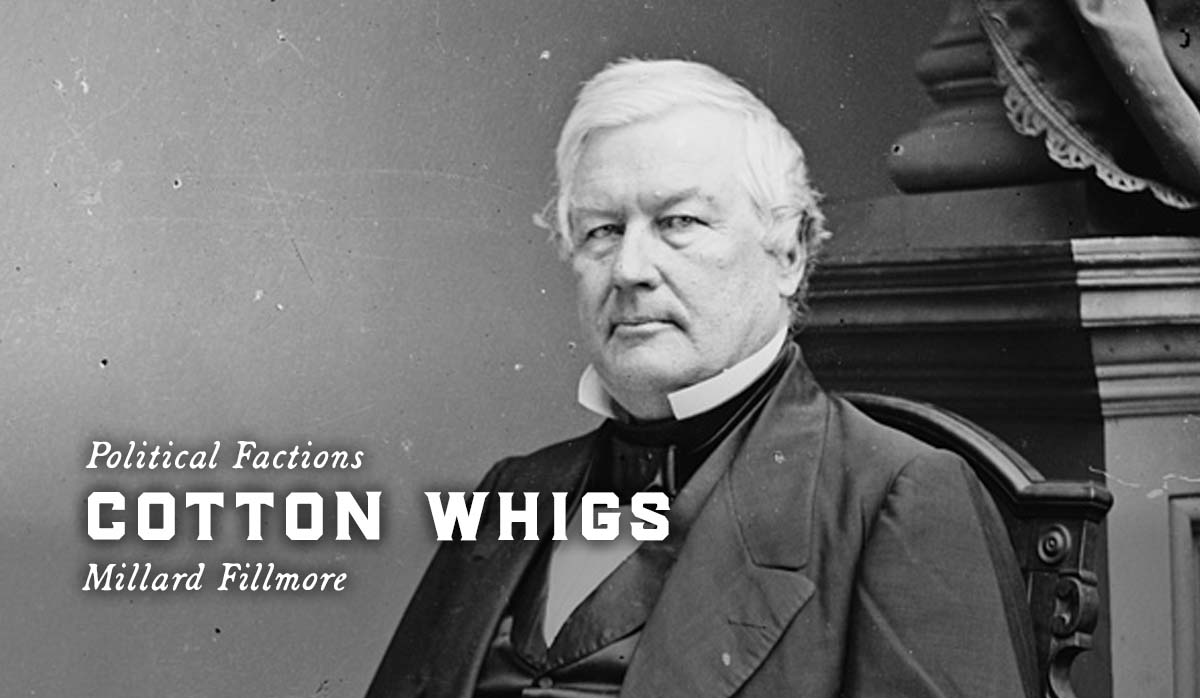
The Cotton Whigs included prominent politicians such as Daniel Webster, Edward Everett, and Millard Fillmore.
They were philosophically opposed by the Conscience Whigs, who opposed slavery, especially its expansion into the Western Territories.
Facts
- Cotton Whigs were northern Whigs who supported the status quo, property rights, and the Union.
- They sought to maintain good relations with their economic and party allies in the South, specifically Whig southern planters.
- They opposed or avoided policies likely to offend southern Democrats.
- Some historians inaccurately apply the label “Cotton Whigs” to refer to southern Whigs.
Significance
The Cotton Whigs are important in American History for their role in maintaining economic ties to the South in the decades leading up to the Civil War and divisions within the Whig Party.
AP US History
The Cotton Whigs are part of the following units, topics, and chapters in the AP US History curriculum:
- The South and the Slavery Controversy (1793–1860)
- Manifest Destiny and Sectionalism (1841–1848)
- Renewing the Sectional Struggle (1848–1854)
Terms
Conscience Whigs — An antislavery faction within the Whig Party in New England during the 1840s who sought to end slavery by working within the American political system. They played an important role in the establishment of the Free Soil Party, the precursor to the Republican Party.
Edward Everett (1794–1865) — Everett was a Massachusetts politician who received his education at Harvard University and served as a Unitarian clergyman, educator, and editor of the North American Review. He represented Massachusetts in the U.S. Congress from 1825 to 1835, opposed Andrew Jackson’s policies, and supported the Second Bank of the United States. Everett later served as governor of Massachusetts, U.S. minister to Great Britain, and Secretary of State under President Millard Fillmore.
Millard Fillmore (1800–1869) — Fillmore was a self-educated lawyer from the Burned-Over District of New York who rose to prominence in the Anti-Masonic Movement. He served in the New York state legislature and the U.S. House of Representatives, aligning with the Whig Party and supporting Henry Clay. He played a key role in the passage of the Tariff of 1842 and later became the 13th President of the United States after succeeding Zachary Taylor in 1850.
Daniel Webster (1782–1852) — Webster was a prominent lawyer and statesman from New Hampshire who served in the U.S. Senate during two periods: 1827–1841 and 1845–1850. He was a leading opponent of Jacksonian Democracy and played a key role in the Webster–Hayne Debate of 1830, advocating for the Union during the Nullification Crisis. Webster also served as Secretary of State under William Henry Harrison and John Tyler and negotiated the Webster–Ashburton Treaty (1842), which established part of the border between the United States and Canada.
