
Summary
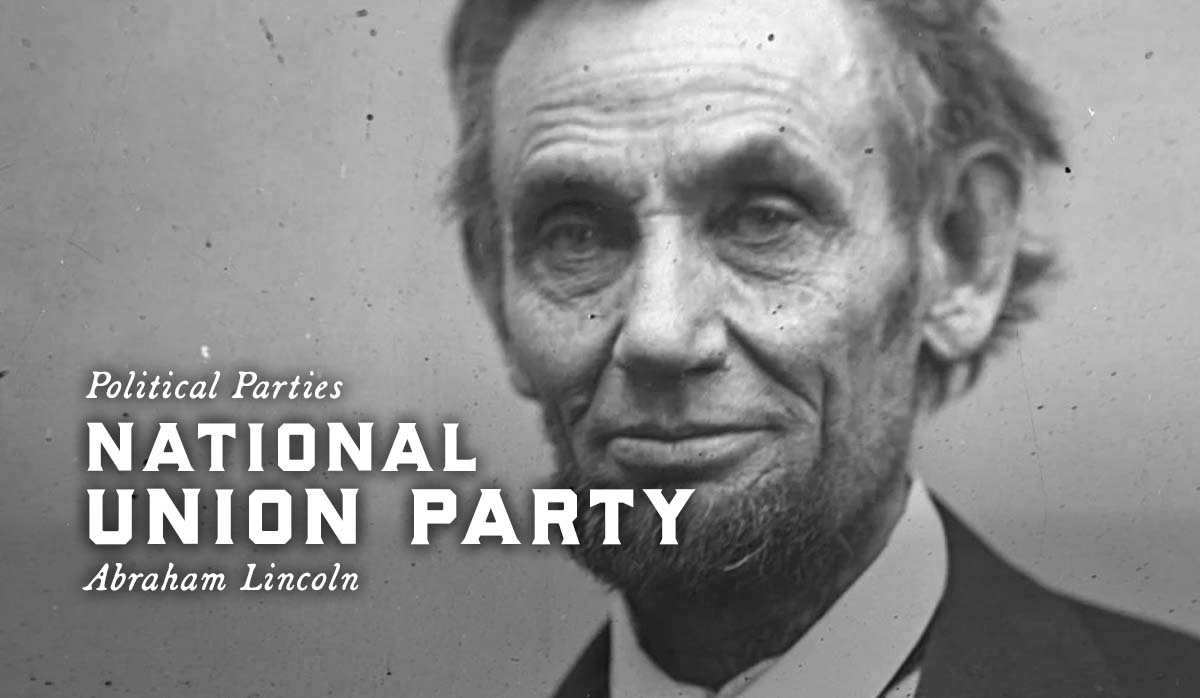
The National Union Party was the name Abraham Lincoln and the Republicans adopted when they worked with War Democrats, a faction that supported the use of military force against the Confederate States of America. The coalition often ran War Democrats as candidates in state and local elections. This name helped Democratic voters support pro-war candidates without voting directly for the Republican Party. Lincoln ran for reelection under the National Union Party label in the Presidential Election of 1864.
Facts
- On September 5, 1861, War Democrats met with Republicans in Columbus, Ohio, and formed a coalition known as the National Union Party.
- David Tod ran for Governor of Ohio in 1861 as a member of the National Union Party. He defeated Peace Democrat Hugh J. Jewett to become Ohio’s 25th Governor.
- On June 7, 1864, the National Union Party nominated Abraham Lincoln for President and Andrew Johnson for Vice President.
- The party’s platform called for the “utter and complete extirpation” of slavery “from the soil of the Republic.”
- The Lincoln-Johnson ticket won the Presidential Election of 1864.
- The party was short-lived and collapsed following the Lincoln Assassination.
- Andrew Johnson used the name during the 1866 elections in an effort to oppose Radical Republicans and Congressional Reconstruction.
Significance
The National Union Party is important in American History for the role it played in helping President Abraham Lincoln win reelection in 1864.
AP US History
Definition
National Union Party — The National Union Party was a political coalition formed by Abraham Lincoln, Republicans, and War Democrats. The coalition often put War Democrats on the ballot in close state and local elections. It also gave Democratic voters a way to support pro-war candidates without directly backing the Republican Party. Lincoln used the label for the 1864 Presidential Election.
Alignment
The National Union Party is part of the following units, topics, and chapters in the AP US History curriculum:
