
Summary
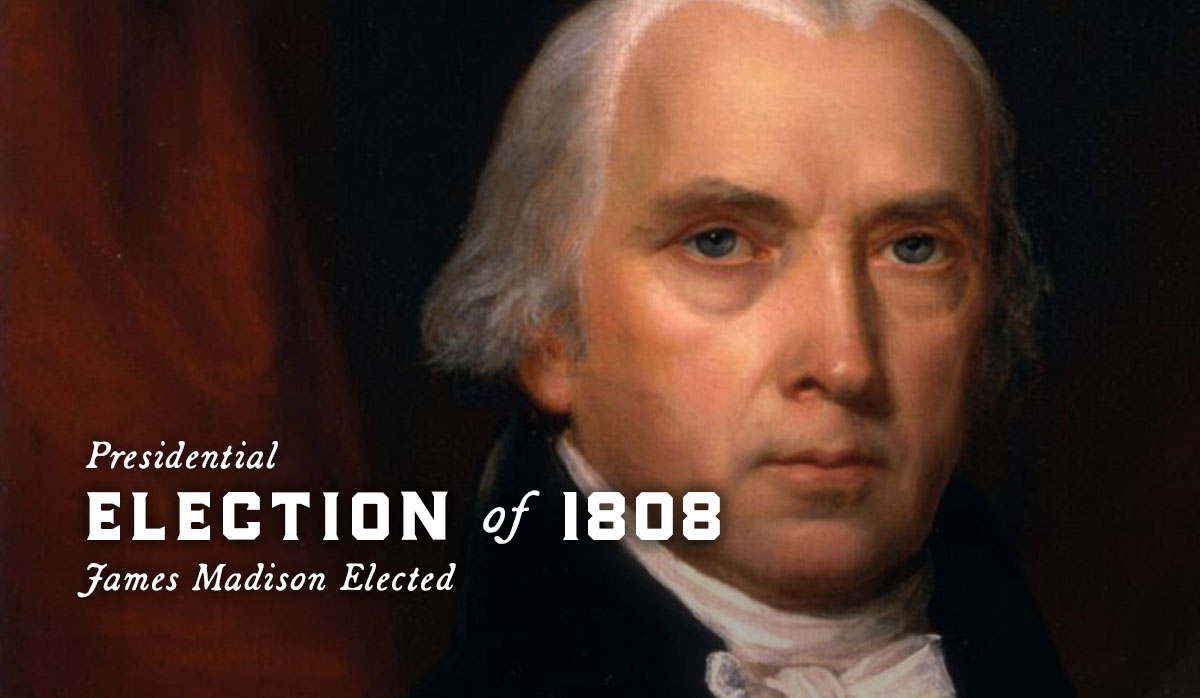
The Election of 1808 took place after Thomas Jefferson decided not to seek a third term, following George Washington’s example of serving no more than two terms. The Republican congressional caucus selected Secretary of State James Madison as Jefferson’s successor and kept George Clinton on the ticket as Vice President. Madison and Clinton defeated the Federalist ticket of Charles C. Pinckney and Rufus King, winning 73% of the electoral vote.
Facts
- Dates: November 4–December 7, 1804.
- Primary Candidates for President: James Madison (Democratic-Republican), Charles Cotesworth Pinckney (Federalist).
- Primary Candidates for Vice-President: George Clinton (Democratic-Republican), Rufus King (Federalist).
- Outcome: Madison was elected President, while Clinton was reelected Vice President.
- Part of: United States Presidential Elections, Virginia Dynasty, Jefferson Administration.
- Era: Early Republic, Age of Jefferson.
Two-Term Precedent
- Thomas Jefferson decided he would not seek a third term as President.
- He did not want to break George Washington’s example of serving more than two terms.
- His reputation was also tarnished by the controversy surrounding the Embargo Act of 1807, which banned American merchants from trading with foreign nations.
Jefferson’s Successor
- In May 1808, the Democratic-Republican Party’s congressional caucus chose James Madison as Jefferson’s successor.
- Madison was serving as Secretary of State.
- George Clinton remained the party’s choice for Vice President.
- Dissident Southern Republicans, led by John Randolph, tried to promote James Monroe as an alternative to Madison.
- The effort to replace Madison with Monroe did not succeed.
Federalist Ticket
- The Federalist Party again nominated Charles C. Pinckney and Rufus King.
- Pinckney and King performed slightly better than they had in the 1804 Presidential Election.
- Anger over Jefferson’s embargo helped the Federalists regain political control in several New England states, especially Massachusetts, which still included Maine.
Significance
The Presidential Election of 1808 is important to American History because the Democratic-Republican ticket won, even though incumbent President Thomas Jefferson declined to run for a third term, following the precedent set by George Washington. The outcome of the election indicated concerns about Democratic-Republican policies and allowed Federalists to gain traction in parts of New England.
AP US History
Alignment
The Presidential Election of 1808 is part of the following units, topics, and chapters in the AP US History curriculum:
Terms
Electoral College — The body that meets every four years to elect the President and Vice President of the United States, in a process established by Article II of the Constitution. Each State in the Union has delegates, or Electors, who cast ballots for both offices. The number of Electors for each state is determined by the number of members it has in the two houses of Congress. Today, most Electors are required to cast their votes for the candidates who win their state’s popular vote.
Federalist Party — Established by Alexander Hamilton in 1791, it was the first political party in the United States. Federalists were advocates of a strong national government and a broad interpretation of powers granted to the Federal Government by the United States Constitution. The party declined in the early 19th Century due to internal divisions, opposition to the War of 1812, and a shift in public opinion towards their rivals, the Democratic-Republicans.
Democratic-Republican Party — Founded by Thomas Jefferson and James Madison in 1972, it opposed the Federalist Party and was the second political party in the United States. The Democratic-Republicans favored a strict interpretation of the Constitution, a weak central government, and strong state governments. The party split in the mid-1820s, and a faction that emerged from it exists today as the modern Democratic Party.
First Party System — The name given to the nation’s first system of political parties, in which the Federalist Party clashed with the Democratic-Republican Party over how to protect the United States during the Federalist Era, when the French Revolution (1789–1799) threatened stability in Europe. The rivalry between the two parties contributed to the outbreak of the War of 1812 with Britain. It was followed by the Second Party System in the 1830s.
Virginia Dynasty — The Virginia Dynasty refers to the election of Virginians as President in eight of the first nine Presidential Elections. The Presidents who were part of the Virginia Dynasty were George Washington, Thomas Jefferson, James Madison, and James Monroe. The Virginia Dynasty ended with the election of John Quincy Adams in 1824.
Jeffersonian Democracy — Jeffersonian Democracy refers to the ideology of the Democratic-Republican Party during the presidencies of Thomas Jefferson, James Madison, and James Monroe. This ideology focused on a strict interpretation of the United States Constitution, personal responsibility to remain virtuous and resist corruption, protection of personal liberties, and the promotion of agriculture.
Age of Jefferson (1800–1824) — The Age of Jefferson was an era that promoted the ideals of “Jeffersonian Democracy,” including a strict interpretation of the United States Constitution, adherence to republican principles, and the promotion of agriculture. It was highlighted by the decline of the Federalist Party during the First Party System, which allowed the Democratic-Republicans to usher in the “Era of Good Feelings.” The Presidents during this era were Thomas Jefferson, James Madison, and James Monroe. Key events were the Revolution of 1800, the Louisiana Purchase, the Lewis and Clark Expedition, the Marbury v. Madison decision, the War of 1812, and the issuance of the Monroe Doctrine.
