
Definition
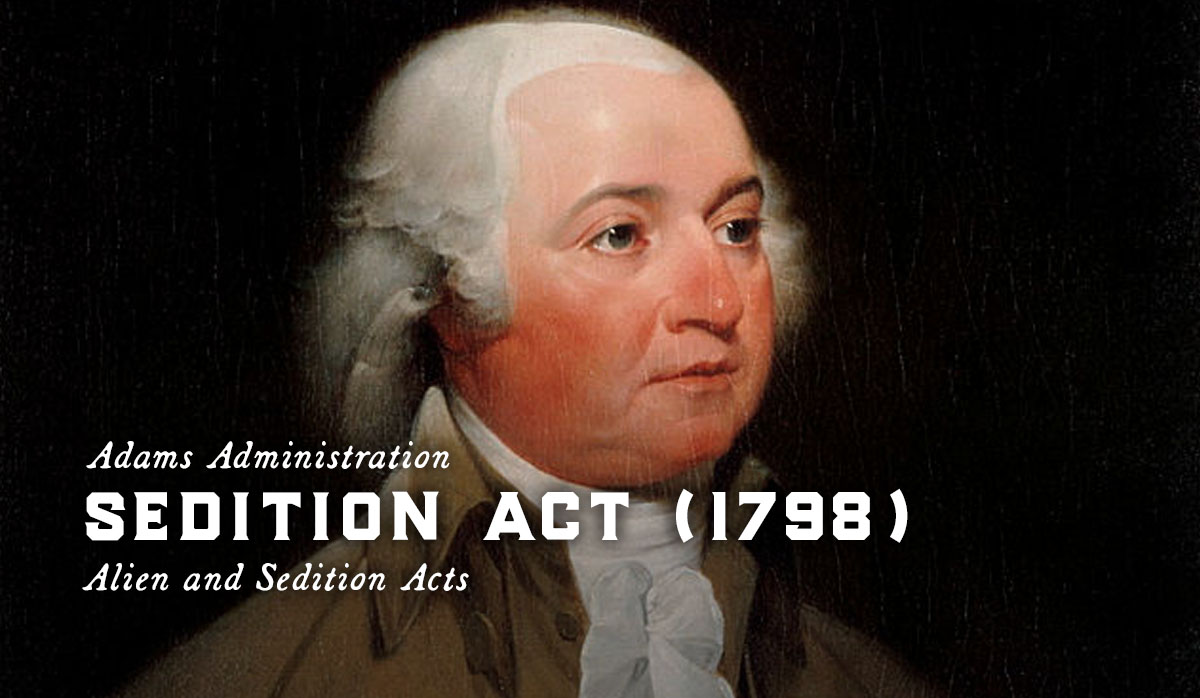
The Sedition Act was passed in 1798 by the Federalists after the release of the XYZ Dispatches increased their power in Congress, and was signed into law by President John Adams. The act criminalized certain opposition to government laws and the publication of false or malicious writing against the Federal Government. Federalists defended the law by arguing that truth could be used as a defense and that juries could judge such cases. Democratic-Republicans argued that it violated the First Amendment and Republican principles. Secretary of State Timothy Pickering used the law against leading Democratic-Republican newspapers before the 1800 Presidential Election. Efforts to continue the law after March 1801 failed, but the debate over it shaped partisan politics during the First Party System.
Facts
- Date Enacted: July 14, 1798.
- President: John Adams.
- Part of: Alien and Sedition Acts, Presidency of John Adams.
- Significance: The Sedition Act is important to American History because it contributed to the downfall of the Federalist Party in the Presidential Election of 1800.
Origins
- The Federalist Party supported the measure in the Fifth Congress after the release of the XYZ Dispatches helped it gain control of the national legislature.
- Federalists designed the law in part to prepare for the possibility that the Quasi-War with France might not escalate into a fully declared war.
- Federalist leaders hoped that a war with France would erode growing American support for France.
- If war did not achieve that goal, the Adams Administration could still use the Federal Courts to control the press, especially Democratic-Republican publications.
Provisions
- The Sedition Act of 1798 made it a federal crime to “unlawfully combine or conspire . . . to oppose any measure…of the Government of the United States…or to impede the operation of any law of the United States” through “insurrection, riot, unlawful assembly, or combination.”
- The law also made it a crime “to print, utter or publish…any false, scandalous and malicious writing…against the Government of the United States.”
Opposition
- Members of the Democratic-Republican Party argued that the law violated the First Amendment.
- Federalists responded by saying the law expanded Freedom of the Press because it allowed the accused to prove whether their statements were true.
- Federalists also argued that giving juries the power to judge that claim protected liberty.
- Under the common law of seditious libel, juries could decide only whether publication had taken place.
- Under that older legal rule, truth was not accepted as a defense.
Enforcement
- Secretary of State Timothy Pickering directed the partisan enforcement of the Sedition Law.
- His administration of the law led to the prosecution of most leading Democratic-Republican newspapers before the election of 1800.
- The pattern of prosecutions convinced many Americans that giving juries the power to judge the truth of a political opinion did not truly protect Freedom of the Press.
Report of the Committee
- James Madison argued in his Report of the Committee that granting the federal government such power was incompatible with Republicanism.
Effects
- Federalists tried to extend the Sedition Act past March 1801 in the Sixth Congress.
- These efforts failed.
- Democratic-Republican criticism of the “truth” test led many Federalists to believe that the Democratic-Republican press had fallen out of favor.
- This belief encouraged the Federalist Press to act with greater recklessness during the rest of the First Party System.
- Public backlash against the Alien and Sedition Acts contributed to the Democratic-Republican victory in the Presidential Election of 1800.
AP US History
Alignment
The Sedition Act is part of the following units, topics, and chapters in the AP US History curriculum:
- Launching the New Ship of State (1789–1900)
- Triumphs and Travails of the Jeffersonian Republic (1800–1812)
- Shaping the New Republic (APUSH 3.10)
Vocabulary
Adams Presidency (1797–1801) — The Presidency of John Adams was from March 4, 1797, to March 3, 1801. He was elected as the Second President of the United States in 1796. He ran for a second term in 1800, but was unsuccessful, losing to Thomas Jefferson. During his four years in office, Adams was plagued by a political rivalry with Alexander Hamilton, a falling out with Thomas Jefferson, and political intrigue with France.
XYZ Dispatches (1798) — The XYZ Dispatches were a record of diplomatic exchanges between American commissioners and intermediaries on behalf of French Foreign Minister Talleyrand. They revealed French demands for an apology, a loan, and bribes from the United States. Americans responded with outrage, pushing the nation into the Quasi-War with France.
XYZ Affair (1797–1800) — The XYZ Affair was a diplomatic scandal between the United States and France that led to an undeclared naval war known as the Quasi-War. The XYZ Affair played a significant role in shaping American foreign policy and domestic politics, and contributed to the political divide that eventually led to the Civil War.
Quasi-War (1798–1800) — The Quasi-War was an undeclared naval war between the United States and France during the Presidency of John Adams. It grew out of the XYZ Affair and ended when French politics changed direction after Napoleon came into power and the two nations signed the Treaty of Mortefontaine.
Alien and Sedition Acts (1798) — The Alien and Sedition Acts were four laws passed by the Federalist-controlled Congress and signed by President John Adams, intended to reduce foreign influence in the United States and public criticism of the government. However, the laws were controversial and contributed to the Democratic-Republican Party’s rise to power in 1800.
Virginia and Kentucky Resolutions (1798–1799) — The Virginia and Kentucky Resolutions were written by James Madison and Thomas Jefferson in response to the Alien and Sedition Acts. The Resolutions established the concept of Nullification.
Kentucky Resolutions (1798–1799) — The Kentucky Resolutions were a set of resolutions drafted by Thomas Jefferson that declared the Alien and Sedition Acts unconstitutional. Jefferson argued the acts were void and urged other states to take steps to block enforcement. The Kentucky Resolutions are known for advancing the idea that states could determine the constitutionality of federal laws.
Virginia Resolutions (1798) — The Virginia Resolutions were a series of resolves drafted by James Madison in 1798 that challenged the constitutionality of the Alien and Sedition Acts. They are known for advancing the idea that states could determine the constitutionality of federal laws, although Madison argued this was not their purpose.
Report of the Committee (1800) — The Report of the Committee was James Madison’s reply to state legislatures that had criticized the Virginia Resolutions, in which he had argued the Alien and Sedition Acts were unconstitutional.
Nullification — Nullification is the idea that a state can void a federal law. It was developed as part of John C. Calhoun’s South Carolina Exposition and Protest (1828). Calhoun based some of his reasoning on the Virginia and Kentucky Resolutions (1788–1799), and Nullification became a critical issue during the Nullification Crisis (1832–1833) and South Carolina’s threat to secede from the Union.
Secession — Secession refers to the idea that states could withdraw from the United States and create an independent country. Although no state seceded until Abraham Lincoln was elected President in 1860, political leaders had threatened secession for decades. In the early Republic, Northerners threatened secession more often than Southerners, including Federalist Leaders in New England. Later, South Carolina raised the issue in response to tariff disputes and growing antislavery pressure from the North.
Republicanism — Republicanism is an ideology that supported the superiority of a Republic, a form of government in which an elected executive shared formal power with elected representatives of the people. It differs from democracy because the people act through representatives instead of directly. This system is designed to combine guidance from the best men with protection against elite oppression, while allowing the people to remove unfaithful representatives from office.
First Party System — The First Party System is the name historians have given to the nation’s first system of political parties. It set the Federalist Party against the Democratic-Republican Party in an ideological struggle over how to protect the United States during the New Nation Era, when the French Revolution threatened stability in Europe. Their rivalry between the two parties contributed to the War of 1812 with Britain, a conflict that nearly led to the breakup of the nation. It was followed by the Second Party System in the 1830s.
Appendix
History
AHC Note — This short history of the Sedition Act is adapted from the U.S. National Archives and Records Administration.
Passed in preparation for an anticipated war with France, the Alien and Sedition Acts tightened restrictions on foreign-born Americans and limited speech critical of the government.
In 1798, the United States stood on the brink of war with France. The Federalist Party, which advocated for a strong central government, believed that Democratic-Republican criticism of Federalist policies was disloyal and feared that “aliens,” or non-citizens, living in the United States would sympathize with the French during a war.
As a result, a Federalist-controlled Congress passed four laws collectively known as the Alien and Sedition Acts. These laws raised the residency requirements for citizenship from five to 14 years, authorized the president to deport “aliens,” and permitted their arrest, imprisonment, and deportation during wartime. The Sedition Act made it a crime for American citizens to “print, utter, or publish…any false, scandalous, and malicious writing” about the government.
The laws were directed against Democratic-Republicans, the party typically favored by new citizens. The only journalists prosecuted under the Sedition Act were editors of Democratic-Republican newspapers.
Sedition Act trials, along with the Senate’s use of its contempt powers to suppress dissent, set off a firestorm of criticism against the Federalists and contributed to their defeat in the election of 1800, after which the acts were repealed or allowed to expire. The controversies surrounding them, however, provided for some of the first tests of the limits of freedom of speech and the press.
Transcript
AHC Note — The following is the full text of the Sedition Act of 1798.
FIFTH CONGRESS OF THE UNITED STATES:
at the Second Session, Begun and held at the city of Philadelphia, in the state of Pennsylvania, on Monday, the thirteenth of November, one thousand seven hundred and ninety-seven.
An Act in Addition to the Act, Entitled “An Act for the Punishment of Certain Crimes Against the United States.”
SECTION 1. Be it enacted by the Senate and House of Representatives of the United States of America, in Congress assembled, That if any persons shall unlawfully combine or conspire together, with intent to oppose any measure or measures of the government of the United States, which are or shall be directed by proper authority, or to impede the operation of any law of the United States, or to intimidate or prevent any person holding a place or office in or under the government of the United States, from undertaking, performing or executing his trust or duty, and if any person or persons, with intent as aforesaid, shall counsel, advise or attempt to procure any insurrection, riot, unlawful assembly, or combination, whether such conspiracy, threatening, counsel, advice, or attempt shall have the proposed effect or not, he or they shall be deemed guilty of a high misdemeanor, and on conviction, before any court of the United States having jurisdiction thereof, shall be punished by a fine not exceeding five thousand dollars, and by imprisonment during a term not less than six months nor exceeding five years; and further, at the discretion of the court may be holden to find sureties for his good behaviour in such sum, and for such time, as the said court may direct.
SEC. 2. And be it farther enacted, That if any person shall write, print, utter or publish, or shall cause or procure to be written, printed, uttered or published, or shall knowingly and willingly assist or aid in writing, printing, uttering or publishing any false, scandalous and malicious writing or writings against the government of the United States, or either house of the Congress of the United States, or the President of the United States, with intent to defame the said government, or either house of the said Congress, or the said President, or to bring them, or either of them, into contempt or disrepute; or to excite against them, or either or any of them, the hatred of the good people of the United States, or to stir up sedition within the United States, or to excite any unlawful combinations therein, for opposing or resisting any law of the United States, or any act of the President of the United States, done in pursuance of any such law, or of the powers in him vested by the constitution of the United States, or to resist, oppose, or defeat any such law or act, or to aid, encourage or abet any hostile designs of any foreign nation against United States, their people or government, then such person, being thereof convicted before any court of the United States having jurisdiction thereof, shall be punished by a fine not exceeding two thousand dollars, and by imprisonment not exceeding two years.
SEC. 3. And be it further enacted and declared, That if any person shall be prosecuted under this act, for the writing or publishing any libel aforesaid, it shall be lawful for the defendant, upon the trial of the cause, to give in evidence in his defence, the truth of the matter contained in publication charged as a libel. And the jury who shall try the cause, shall have a right to determine the law and the fact, under the direction of the court, as in other cases.
SEC. 4. And be it further enacted, That this act shall continue and be in force until the third day of March, one thousand eight hundred and one, and no longer: Provided, that the expiration of the act shall not prevent or defeat a prosecution and punishment of any offence against the law, during the time it shall be in force.
Jonathan Dayton, Speaker of the House of Representatives.
Theodore Sedgwick, President of the Senate pro tempore.
I Certify that this Act did originate in the Senate.
Attest, Sam. A. Otis, Secretary
APPROVED, July 14, 1798
John Adams
President of the United States.
